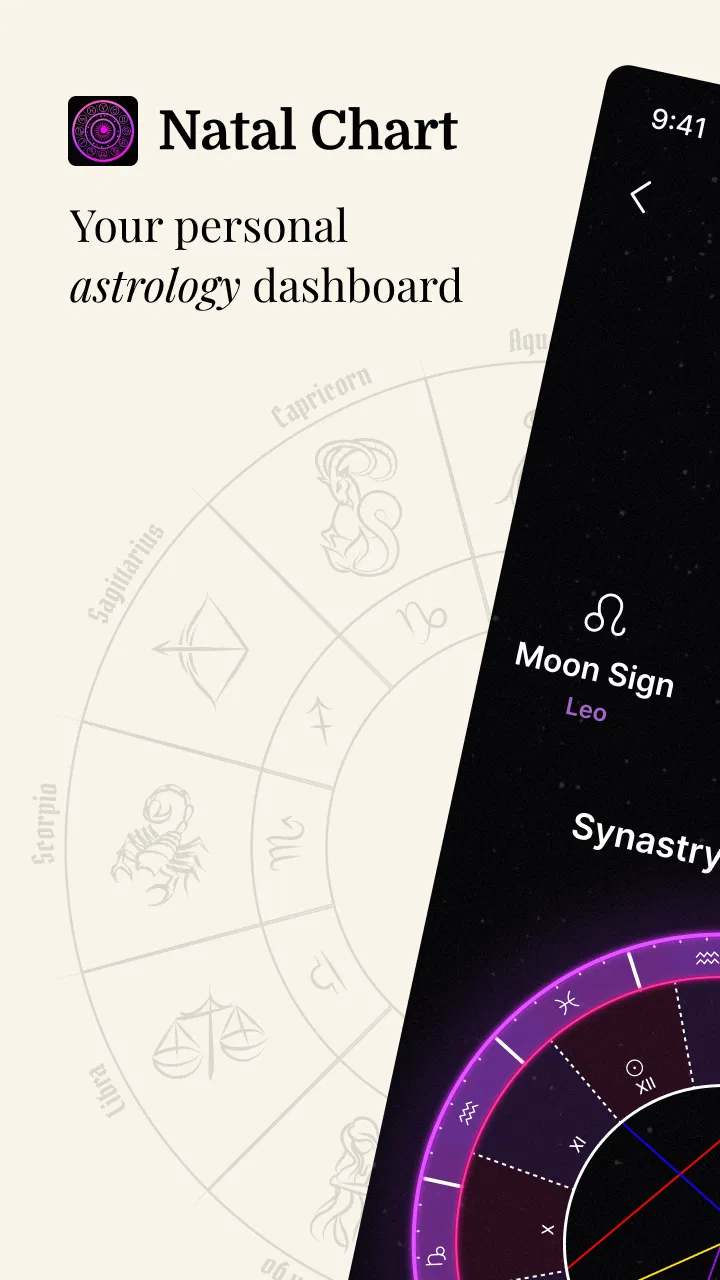
Natal Chart: Astro Horoscope
- 4.0
- Rating
- 1.00M
- Installs
- Free
- Price
 Analysis by App-foxy
I usually approach astrology apps with a simple question: will I still open this after the first week of curiosity? Natal Chart: Astro Horoscope makes a good first impression because it brings several familiar astrology tools into one lifestyle app: a birth chart, relationship comparison through synastry, moon-phase information, and a daily horoscope. That combination gives it more to explore than an app built around a single daily message.
After spending time with it, my opinion is fairly measured. It is an approachable way to organize astrology-related reading, especially if you enjoy checking patterns around your birth details or comparing charts with someone close to you. At the same time, its lasting value depends heavily on whether you like returning to interpretive content regularly. The initial discovery is stronger than the long-term routine for some users, so I would treat it as a personal reflection tool rather than a source of firm answers.
What makes the first week appealing
The first session has an obvious sense of discovery. A natal chart feels more personal than a generic zodiac sign because it asks you to look at a broader astrological profile. Instead of stopping at “I am a Taurus” or “I am a Gemini,” the experience encourages you to think about several placements and how they might fit together.
You May Also Like

 Google Keep - Notes and lists
Google Keep’s Quiet Growth Shows the Appeal of Simpler Notes
As mobile work gets busier, Google Keep keeps winning a simple contest: capture a thought quickly, find it later, and get on with the day.

 Blood Strike: 2.5 Anniversary
Blood Strike’s Loadouts Turn Every Drop Into a Tactical Gamble
A close look at Blood Strike’s custom loadouts: how fast access to signature weapons reshapes its battle royale rhythm, rewards preparation, and narrows the gap between fights.

 Pandora - Music & Podcasts
Pandora’s Music Is Easy to Start, but Harder to Recover
Pandora’s strength is its low-effort path from a seed to a station. Its weak spot is how much confidence it asks you to place in connection, setup, and quiet recovery.

 8 Ball Pool
 Is Built on Rivalries, Rematches, and Routine
A close look at the rivalries, rematches, shared routines, and unanswered safety questions that turn a quick pool match into a persistent mobile community.

 Samsung Music
’s Quiet Strength Is Playing What You Already Own
Its reach comes less from spectacle than from dependable access to a personal library. That simplicity is both the app’s strongest retention engine and its ceiling.

 AccuWeather: Weather Radar
AccuWeather Review: A Quick, Clear Forecast for Everyday Decisions
For everyday plans, the best forecast is the one you can understand quickly. AccuWeather makes rain timing, radar, and local conditions easy to act on, with a few trade-offs.
More From Our News Desk



That is the main reason this app is more interesting than a basic horoscope feed. The birth-chart focus gives you something to investigate slowly. I found that the most useful approach was not to read every interpretation as a prediction, but to use each section as a prompt for self-reflection. If a description felt accurate, I considered why. If it did not, I treated that mismatch as a reason to question the interpretation rather than force it to fit.
The synastry element adds another layer for people who enjoy discussing relationships through astrology. It can be a conversation starter with a partner, friend, or family member. I would not use it to decide whether a relationship is healthy or compatible, but it can help two people talk about communication styles, emotional reactions, and expectations in a playful way.
The moon-phase material is also easier to revisit than a long birth-chart reading. A daily or periodic lunar check can become a small ritual: looking at the current phase, thinking about what you want to finish, and using the moment to pause. The app works best when you connect that information to your own journaling or planning instead of waiting for the moon phase to provide a specific instruction.
Its daily horoscope gives the first week a convenient rhythm. Opening the app for a short reading takes less commitment than studying a full chart. I can imagine checking it with morning coffee, then returning later to compare the message with the day’s mood. That is not proof that the horoscope predicts events, but it can make an ordinary routine feel more intentional.
There is also a practical advantage in having these areas together. Someone who normally jumps between a chart calculator, a moon calendar, and a horoscope feed may appreciate the simpler starting point. The app is free to download, and its Everyone content rating makes it accessible to a broad audience. DN Solutions presents it as a lifestyle experience rather than a specialist research tool, and that positioning feels appropriate.
How to get more from the initial reading
My first useful tip is to avoid consuming the entire chart in one sitting. Read one part, write down what seems relevant, and return later with a fresh perspective. Astrology apps can create a strong “this sounds like me” reaction when several broad statements appear together. Spacing out the reading helps you notice which ideas remain meaningful after the novelty fades.
A second tip is to separate observation from decision-making. If a synastry interpretation sounds difficult, do not turn it into a verdict about another person. Use it to ask a real question, such as whether both of you feel heard during disagreements. That keeps the app in a healthy role: it can suggest a topic for discussion, but it should not replace direct communication.
A third tip is to save your own notes outside the app if you want to track patterns over time. A daily horoscope is easy to forget, while a short note about your mood, plans, or unexpected events gives you something concrete to review. This makes the experience more reflective and less passive.
Does it keep earning attention month after month?
The answer depends on which part of the app attracts you. The daily horoscope and moon phases have the clearest recurring value because they change with time. They can support a small habit without demanding a long session. If you enjoy brief check-ins, that may be enough to keep the app relevant.
The natal chart has a different kind of value. Once you have read it carefully, the information itself does not become new every day. Its usefulness comes from revisiting it when your circumstances change. I could see returning to a chart before starting a new job, entering a relationship, or reflecting on a personal transition. In those moments, the same interpretation may feel different because your questions have changed.
Synastry is similarly occasional rather than endlessly renewable. It is most useful when there is a person or relationship you genuinely want to explore. After the initial comparison, repeated checking can become circular. If you find yourself reopening the same interpretation hoping it will change, the app is no longer adding much value.
This is where the product’s long-term appeal becomes more selective. It is not a task manager, fitness tracker, or practical utility that solves a new problem every day. Its recurring value is emotional and reflective. You keep using it because you like the ritual, the language of astrology, or the way it helps you frame personal questions.
I would recommend a monthly routine rather than constant checking. At the start of a month, read the horoscope, review the moon phases, and choose one theme to observe in daily life. At the end, consider what actually happened and what you learned. This approach prevents the app from becoming background noise and gives each visit a purpose.
For people who already follow astrology closely, the app may serve as a convenient home base. For beginners, it offers enough variety to make exploration enjoyable without requiring immediate knowledge of every astrological term. However, advanced users may eventually want deeper explanations, more control over chart interpretation, or a stronger educational layer than a casual lifestyle app typically provides.
What happens when the novelty wears off
The first-week excitement comes from seeing a personal chart and discovering several interpretations. After that, the challenge is repetition. Daily horoscope writing can start to feel interchangeable if you read it without connecting it to a specific question. Moon phases can also lose their impact if they become nothing more than a screen you glance at and close.
To avoid that fatigue, I would give each feature a different job. Use the birth chart for long-term self-reflection, synastry for occasional relationship conversations, moon phases for planning a pause or review, and the daily horoscope for a quick prompt. When every feature is treated as a prediction feed, the experience becomes much flatter.
Another useful habit is to read the app before making your own interpretation, not after searching for confirmation. Decide how you feel about a situation first, then see whether the text offers a new angle. This reduces the temptation to bend every event around a horoscope and makes the app feel more like a journal companion.
The maintenance burden is small, but the attention cost is real
There is no complicated upkeep involved in using the app. The real maintenance is deciding whether your routine remains useful. If you turn on notifications or build a daily checking habit, you should occasionally ask whether the content is helping you reflect or merely filling spare seconds.
That distinction matters because astrology apps can quietly become repetitive. A short reading feels harmless, but opening it several times a day can encourage over-analysis. I would keep the routine limited to one intentional check and perhaps a longer review when you actually have something to think about.
The app is free, which makes trying it relatively easy. It does include optional in-app purchases ranging from a few dollars to several dozen dollars per item. I would not pay immediately just because a reading feels personal. First, use the free experience long enough to decide whether the daily and chart-based content has a place in your routine. A purchase only makes sense if it adds something you will genuinely revisit rather than satisfying first-day curiosity.
The current version is 1.0.17, and the app runs on Android 8.1 or later. That broad compatibility is helpful for people using older Android devices. Still, compatibility alone does not guarantee that the app will suit every phone or personal workflow. I would judge it by how comfortably it fits your reading habits, not simply by whether it installs.
One maintenance issue is interpretive discipline. The more personal the chart feels, the easier it is to give the text too much authority. I would avoid using it for medical, financial, legal, or major relationship decisions. The app can be entertaining and thought-provoking, but real-world evidence and honest conversations should remain more important than an astrological interpretation.
Where fatigue and friction are most likely
The largest weakness is the risk of sameness. A daily horoscope has a built-in limit: even when the wording changes, the basic experience remains a short reading. If you prefer interactive lessons, detailed astronomical information, or practical planning tools, this may feel too passive after the initial exploration.
The birth-chart feature can also be overwhelming for newcomers. A chart may look authoritative because it contains many symbols and categories, but more information does not automatically mean more clarity. I would have preferred to approach it with a notebook and patience rather than trying to understand everything at once.
Synastry carries a special emotional risk. Relationship comparisons are fun when both people treat them lightly, but they can become uncomfortable when one person uses the result to label the other. The app is better suited to open-ended discussion than to ranking partners or searching for proof that a relationship will succeed or fail.
There is also a trade-off between convenience and depth. Having horoscope, moon-phase, natal-chart, and synastry material together is efficient, but a dedicated app in any one of those areas may offer a more focused experience. If you want serious astrology study, you may prefer books, specialist software, or a more educational service. If you want only a quick daily message, this app may offer more material than you need.
The average rating is 3.7 from around 1,800 ratings, with 11 written reviews shown alongside it. I would read that as a sign to keep expectations realistic rather than as a reason to dismiss the app. It has reached over a million installs, so there is clearly broad interest, but popularity does not remove the personal nature of the experience. Whether it becomes useful depends on your tolerance for interpretive content and repetition.
Privacy-minded users should also make their own comfort decision before entering personal birth information. A natal chart naturally depends on details about when and where someone was born. I would only enter information I am comfortable using in an astrology service, and I would avoid adding someone else’s details without their permission. That is a sensible boundary for any app built around personal profiles.
Who should use it and who should move on
I think it is a good fit for someone who wants a friendly introduction to natal charts, enjoys daily horoscope routines, and likes using astrology as a prompt for journaling or conversation. It is also suitable for couples or friends who understand that synastry is entertainment and reflection, not a relationship test.
I would skip it if you want scientifically validated predictions, exact practical guidance, or a highly technical astrology workstation. I would also skip it if you know that daily predictions make you anxious or cause you to second-guess ordinary choices. In that case, a simple journal or moon calendar without interpretive claims may be healthier and more useful.
Compared with reading horoscope columns on social media, the app feels more personal because the chart and relationship angle give you a reason to return to your own context. Compared with a standalone birth-chart calculator, it is broader and more habit-friendly because it also includes daily and lunar content. Compared with an astrology course, however, it is less likely to satisfy someone who wants structured learning and careful explanation.
My long-term verdict
Natal Chart: Astro Horoscope earns a place on my phone only when I use it deliberately. Its strongest qualities are the mix of personal chart exploration, synastry, moon phases, and daily reading, along with an approachable free starting point. The first week is enjoyable because there is plenty to discover, and the app gives beginners a clear way into astrology without requiring them to assemble several tools.
Its lasting value is quieter. The natal chart does not need daily attention, while the horoscope can become repetitive and synastry is naturally occasional. The best long-term routine is to check in with a purpose, keep personal notes, and use the interpretations as prompts rather than instructions. That approach also protects you from the app’s biggest weakness: letting broad statements take over your judgment.
With its Everyone rating, broad Android compatibility, and free entry point, it is easy to try. The optional purchases mean I would take time before spending, especially if the first attraction is simply the excitement of seeing a personalized chart. For me, the app succeeds as a reflective lifestyle companion, not as an authority and not as an essential daily utility.
My recommendation is straightforward: try it if you enjoy astrology and want several related features in one place, then give it a month with a modest routine. If you still find yourself thinking about the readings, using them in journaling, or having better conversations because of them, it has earned its space. If you are only opening it out of habit and forgetting the content immediately, the novelty has probably ended, and another kind of app will serve you better.
FAQs for Natal Chart: Astro Horoscope
01What is Natal Chart: Astro Horoscope used for?
Natal Chart: Astro Horoscope is designed to help users explore astrology through a personalized birth chart. After entering details such as your birth date, exact time, and birthplace, the app presents information about planetary positions, zodiac signs, houses, and possible personality influences. It can also be used for general horoscope reading and self-reflection rather than scientific prediction.
02What information do I need to create a natal chart?
To generate a more accurate natal chart, you generally need your complete date of birth, exact birth time, and place of birth. The time is especially important because it affects the ascendant and house positions. If you do not know your birth time, the app may still provide a basic chart, but some interpretations can be incomplete or less precise.
03Is Natal Chart: Astro Horoscope free to download and use?
The application may be available as a free download, but some features, detailed interpretations, compatibility tools, or additional astrology content can depend on the version installed and may require in-app purchases or a subscription. Before confirming payment, review the app-store listing, trial conditions, renewal terms, and cancellation instructions carefully.
04Can the app predict my future or provide professional advice?
Natal Chart: Astro Horoscope should be treated as an entertainment and self-exploration tool, not as a guaranteed method for predicting future events. Its readings are based on astrological traditions and interpretations rather than verified scientific evidence. Users should avoid relying on the app for medical, legal, financial, relationship, or other important professional decisions.
05Is my birth information safe when using the application?
Because the app may request personal details such as your birth date, time, and location, you should review its privacy policy before creating a profile or synchronizing data. Check how information is stored, whether it is shared with third parties, and whether you can delete your account or data. Only provide details you are comfortable submitting.
Pros
- Clear birth-chart visuals make planetary positions easy to explore.
- Includes compatibility insights for comparing two birth charts.
- Daily horoscope updates provide quick
- personalized readings.
- Useful explanations help beginners understand astrology terminology.
- Clean interface makes switching between chart sections straightforward.
Cons
- Accurate readings require your exact birth time and location.
- Some advanced interpretations may be locked behind a subscription.
- Astrology content is for entertainment
- not scientifically verified guidance.
- Long readings can feel repetitive across different chart sections.
- Ads may interrupt the experience for users on the free version.

Natal Chart: Astro Horoscope
Gallery